The 360° Evidence Flood Is Coming. More Pixels Won't Save You.
Opinions are my own. Everything referenced here is public information.
Bottom line up front: a flood of 360° panoramic video evidence is heading into digital evidence platforms like Evidence.com, driven by retailers retrofitting stores with fisheye cameras and piping footage directly to police. More pixels do not equal more insights. Without AI tooling — cross-camera person tracking, natural-language search, automated redaction — retailers and police will drown in their own gold mine.
Where the flood is coming from
I had a lightbulb moment recently while talking to an asset protection leader at a major retail chain. Retailers are quietly replacing their forests of fixed cameras with ceiling-mounted fisheye cameras. The math is brutal and simple: one fisheye unit replaces four to six traditional cameras, and it has no seams. With fixed cameras, blind spots live in the gaps where two fields of view don’t quite meet. A fisheye simply doesn’t have gaps. Industry surveys suggest over half of major retail brands already use 360° fisheye cameras for loss prevention.
The second force multiplier: the pipe between retailers and police is no longer email and USB drives. NYC now lets store owners share live camera feeds with the NYPD. Platforms like Auror’s Retail Crime Hub let officers request digital evidence directly from retailers inside their existing workflow, reportedly saving 3.5 hours per retail crime report. Today, an estimated 70–90% of retail theft never gets reported to police. Watch what happens to evidence volume when the friction of reporting collapses.
So: cameras that see everything, always, feeding a pipe that’s suddenly frictionless. Volume up, friction down. That’s the flood.
Why 360° footage breaks your existing tools
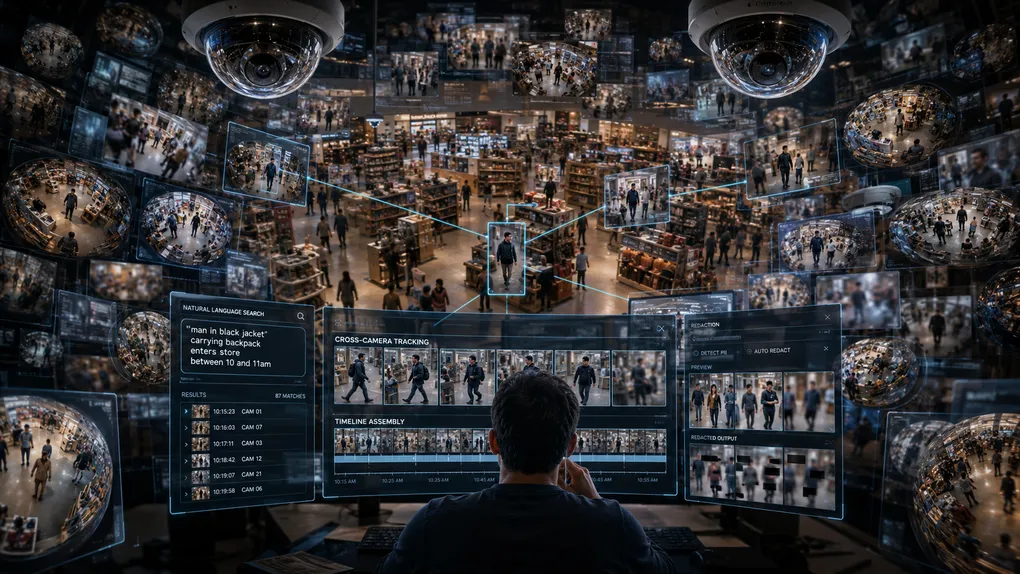
Here’s the part most commentary misses. Retail “360°” is not the stitched, Insta360-style sphere you know from action cams. It’s a single hemispherical lens looking straight down, producing heavily warped donut-shaped footage that needs dewarping software to become human-readable. Your analytics pipeline — trained on decades of rectilinear video — handles this format poorly out of the box. Detail degrades toward the edges. Low-light performance suffers because infrared gets spread across the entire hemisphere.
In other words, the influx isn’t just more video. It’s a different kind of video, arriving at scale, that legacy review workflows were never designed for.
The needle didn’t get harder to find. The haystack got 10x bigger.
Picture the canonical case. A retailer discovers high-value merchandise missing — not during the theft, but days later during inventory. Somewhere in terabytes of fisheye footage across dozens of cameras is the answer. A human reviewer scrubbing timelines will take days. Police officers wearing panoramic body cameras will face the same problem on the street: the critical moment is in there somewhere, sphere-shaped, unindexed.
This is where AI stops being a buzzword and becomes the only viable answer. Five capabilities matter:
- Reverse-tracing from the object. Watch the shelf zone backward through time until the item vanishes, then pivot to the person.
- Cross-camera re-identification. Appearance-based tracking — clothing, build, gait, not face recognition — that follows one individual across every camera in the store, from shelf to exit to parking lot. Click once, get their entire journey.
- Natural-language search. “Person in red hoodie near electronics, 2–4pm.” Terabytes of footage become a queryable database instead of an archive.
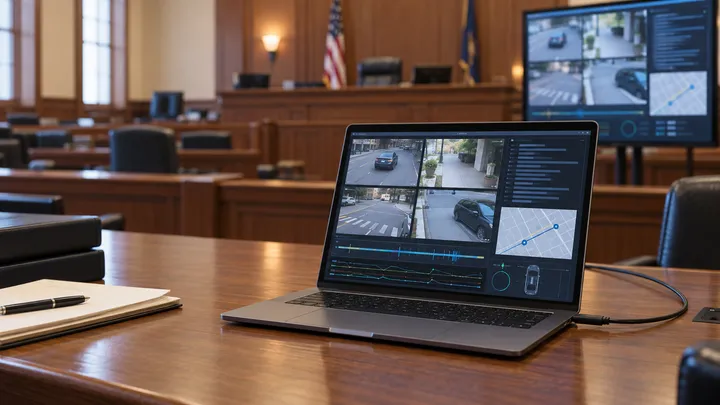
- Automated timeline assembly. Stitch the relevant segments from every camera into one chronological, court-ready clip, with a dewarped virtual camera always framing the subject. Days of review compressed into minutes.
- Redaction at scale. The unglamorous one that makes everything else legally usable. A fisheye camera captures everyone, all the time — every shared clip contains dozens of innocent bystanders. Without automated blurring, the privacy review burden alone would make 360° evidence sharing impractical.
More pixels ≠ more insights
The seductive assumption is that total coverage means total awareness. It doesn’t. A camera with no blind spots produces evidence with no boundaries — every incident now ships with hours of context, dozens of bystanders, and a format your tools can’t natively read. Coverage is not the bottleneck anymore. Review capacity is.
The agencies and retailers who win the next five years won’t be the ones with the most cameras. They’ll be the ones whose evidence platform can answer a question — who took this, where did they go, show me only what matters — in minutes instead of days. Everyone else will own a gold mine they can’t dig.
The flood is coming either way. The only choice is whether you’re holding a shovel or a teaspoon.
Building something meaningful?
I love connecting with people who are using technology to solve real problems. Whether you want to discuss AI, product management, or just say hi — I'd love to hear from you.
Get in Touch